
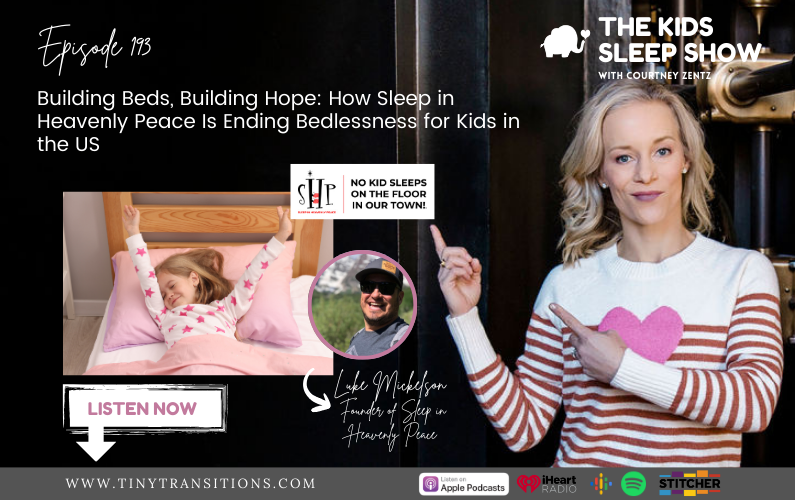
When Luke Mickelson set out to build a single bed for a child in need, he had no idea it would spark a nationwide movement.
In this inspiring episode, we sit down with Luke, founder of Sleep in Heavenly Peace (SHP) to hear how one act of kindness turned into a life-changing mission. From his small-town roots in Kimberly, Idaho, to becoming a CNN Hero and national voice for service, Luke shares how SHP has grown into over 400 chapters, delivering more than 315,000 beds to kids who would otherwise be sleeping on the floor.
Episode Highlights:
-
- The humble beginnings of SHP and its viral growth
- The real impact of “bedlessness” on families across the U.S.
- Why Luke believes in Humans Helping Humans
- How tiny moments of service can create lasting change
- What it takes to lead with heart in your home, business, and community
- Featured on Good Morning America, NBC Nightly News, People Magazine, and more
Luke’s message is clear: Every child deserves a bed. Every community has the power to help.
Tune in and discover how you can be part of the movement.
Sleep Struggles Solved + Results Guaranteed
[xyz-ihs snippet=”Transcript-Start”]
Welcome to the Kid Sleep Show podcast, where we dive into the magical world of sleep and all things parenting. Join us as we embark on a journey filled with expert advice, practical tips, and heartwarming stories that will transform your little ones into sleep superheroes and empower you to navigate the beautiful chaos of parenting. I’m your host, Courtney Zents, and I’m on a mission to change how the world views sleep and provide accessible sleep coaching resources for all families to build healthy sleep habits in their home for children and adults of all ages.
As an award-winning speaker, author, and pediatric sleep expert, myself and my team of consultants work intimately with families around the world to teach healthy sleep habits to children and adults. I believe wholeheartedly that sleep is the foundation for which a happy home is built, so let’s sleep together. Hey, everyone.
Welcome to this week’s episode of the Kid Sleep Show podcast. I’m your host, Courtney Zents, and I’m excited to be joined by Luke Mickelson. He is the founder of an amazing nonprofit I want to tell you all about, but I’m actually going to allow him to introduce himself and talk about how he founded Sleep in Heavenly Peace.
Welcome to the show, Luke. Thanks, Courtney. Thanks for having me on.
I’m excited for you to be here because I am so passionate about sleep, but also the ability for people to get a good quality night of rest, which is, I know, where you come in. So let’s introduce our listeners to Sleep in Heavenly Peace. What is it and why did you start it? Right on.
Well, thank you for having me on. Just a little background about myself. It’s pretty simple, guys.
I’m a farm kid from Idaho. Actually, I was from a small town in Idaho called Kimberly. I think that does play a little bit of a role in how all this crazy train happened.
Being from a small town, 4,000 people, and because you know everybody and they know you and good and bad, you develop kind of a bond with people and certainly a care for helping each other out. I think it’s different in some of these bigger cities. You don’t make such a connection with so many people.
For example, when my parents divorced when I was young, just getting into high school, my mom had five kids and she was doing her thing the best she could. My dad was out of the picture. We had one Christmas.
I think it was the Christmas right after they got divorced. We knew as kids we weren’t going to have any presents. My mom couldn’t afford that.
Well, I walked out to the mailbox, opened the mailbox to get the mail, and there’s $1,500. That was from the community. That was from members and friends and stuff that we knew.
That’s just what you get when you live in a small community for the most part. You have this sense of connection, bonding. You have this sense of care and empathy that just inherently comes with that.
My high school is small. I graduated with 69 people. I love that because I think that plays a big role in where I ended up with Sleep & Empathy Peace and how this came about.
I think the culture that I always wanted to develop or always wished that charity had, we had a chance to develop that. As the story goes, being a small town, I served in a lot of areas. I did a lot of service work.
I coached football. I did all that kind of fun stuff. In my church community, I had a position called Young Men’s President.
Now, what that is, basically in the South, some people would call it a youth pastor, although I’m not a pastor. I worked well with kids. I coached and did all this stuff.
They saw some benefits there. Basically, I was responsible for the spiritual growth as well as the activity arm of the boys, ages about 12 to 17 or so. The activity arm was Boy Scouts.
Basically, I was the leader of the leader of the Boy Scouts. In this role, oftentimes once a month or so, we’d get together with other auxiliary leaders in the church. We’d talk about events that were happening, things that we were doing, and people in the community we were helping out.
From a small community, I grew up there. I rode my bike everywhere. I knew that town in and out.
There wasn’t a street I hadn’t been down, or at least I thought. When someone was talking about this family, and they talked about where they lived, it was in an apartment complex I didn’t even know existed, which was like the first bell that went off. I’m like, wait a minute, where is this place? Then the mom, I didn’t really know her personally, but she drove school bus for the school.
The dad was suffering from some mental health issues. He had a hard time holding a job. They were just in hard times.
The church was talking about what they were doing for him, food, clothing, rides, and whatever. Well, someone who had been to the house had mentioned that the kids didn’t have any beds. Almost like just a passing comment.
It just really hit me. I was like, wait a minute. I stopped everybody.
I’m like, wait a minute, you said they don’t have any beds. Okay, what does that mean? They’ve got a mattress or something. She said, no, no, they’re literally sleeping on the floor with blankets.
In my head, I’m like, you’ve got to be kidding me. This is a thing? No one’s helped them with this? It was kind of shocking. As a leader of a Boy Scout group, some of the challenges we always had was trying to find activities that were fun to do that didn’t involve a screen, which is hard to do nowadays and something they’ll be excited about.
Well, when I heard about this, there’s two things I thought of. The first thing I thought of was my own kids, sleeping on the floor and what that would be like day in and day out. The miserable situation they’d be in, the attitude they would be in, all the aspects of having poor sleep.
When I’ve had a bad night’s sleep, I’m not the best guy in the world either. So I thought about my kids. Then the second thing I thought of was like, oh my gosh, here’s a great opportunity that I could get an Xbox controller out of these boys’ hands.
We’ll put a drill and a sander in it. We’re going to teach them something. I’d never built furniture in my life, but like you, I can tinker.
I guess I did build a table a long time ago, but I’d never built a chair. I wasn’t a stranger to tools. The honest truth is I had to buy my wife’s tools at the time.
I had to borrow hers. I knew we’d get along. My husband, when we got married, he’s like, what do you know? I’m like, I got a hammer drill.
I got a circular saw. He’s like, all right, yes. Awesome.
My wife at the time, she had a framing business, so she built frames and stuff. She had some tools that I didn’t have, and I had to borrow those, which is fine. The kids came over that week.
For a couple of nights that week, me and the Boy Scouts built this bunk bed. I had a bunk bed that my daughter was using, and I patterned it after that bunk bed. Of course, I made the cuts easy and the process to put it together easy because I’m dealing with Boy Scouts.
I was really amazed at how fun it was and how much joy they had in it. I like to think it’s because they knew where it was going. We were hitting all cylinders on teaching them something, a good activity, and having fun, and going to a good cause, and helping a family and the community, the whole nine yards.
Well, the time came to deliver it. The problem I had was a great problem, but the word kind of got out. We were building a bed for a family in the community that had kids sleeping on the floor.
People were curious about that because, like me, they’d never heard that before. They never thought a child was sleeping on floors. The kids’ parents showed up.
Other leaders showed up. Next thing you know, there’s like 20 people ready to go do this delivery of this one bed. I’m like, okay, this is way too much here, guys.
I’ll stay back. I’ve got to clean my garage. It was the beginning of December in the middle of Idaho, not the warmest time in the world.
I’ve got to park my cars. Anyway, I had to clean my garage. Well, the next day at church, I heard how amazing this delivery was.
These kids, they saw the conditions that these kids were sleeping in. They saw the joy that they got when they delivered these kids a bed. Of course, the family and their excitement.
I heard from kids. I heard from their parents. I heard from other leaders of just how amazing it was.
I was super happy, but also, honestly, a little jealous. I missed out on that. A little bit of a backstory too is at the time, I’m going through kind of like a midlife crisis.
I wasn’t a depressed person, but I didn’t feel myself. For a couple of years, I was going through a big faith crisis. I didn’t know really what I believed anymore.
I didn’t know my fit. I had a great job. On paper, I had nothing to complain about, which almost made it worse, Cordy.
I’m like, gosh, people die to live in my lifestyle. I just did not feel satisfied. I didn’t feel fulfilled.
Even though I was successful, or at least what I thought was success, I just didn’t feel really fulfilled. This one service project really just filled the gaps in my heart. It was over.
Life creeps back in. You can just feel yourself falling back into the same rut. You don’t want to be there.
I didn’t. I knew that about myself. One night, just a couple of days after this experience, I’m sitting on the couch.
Me and my kids are watching Big Bang Theory. It’s kind of like a program we get to watch. A commercial came on or something like that.
Anyways, my kids were talking about another Xbox or an Xbox game or something, a gift. It was a present because it was going to be Christmas that they wanted to get that they knew I wasn’t going to buy for them. I don’t know.
It was just a perfect storm. It’s like, here I’m struggling. I’m trying to be a good dad.
I’m trying to get myself psyched out of this hole that I feel like I’m in. I just did this amazing project where we delivered a bed to a child that didn’t have one. You guys want to complain about not getting an Xbox? The thought came to my head.
I’m like, listen, Luke, I can sit here and talk about this experience. I can show them videos and have them listen to the experiences of other people. Or, you know what? I can get my butt off the couch.
I can get out to the garage. I got extra wood. I can build another bed.
Right then, right in the middle of the program, I just stood up and started walking to the garage. I didn’t say anything. I had to get moving or else I wasn’t going to.
My kids were like, Dad, where are you going? I said, you know what? I’m going to the garage. I’m going to build another bunk bed. You’re going to come with me.
We had a great time. I got pictures of my daughter and her little pink tutu drilling holes. My son in his Boise State jersey pounding away.
We just had a lot of fun. Of course, I built this. I wanted them to be a part of it, just like my Boy Scouts.
I wanted them to enjoy the satisfaction, the fulfillment that comes from serving others, from stop looking at yourself, and also to appreciate the things that they had, like a bed. But when that’s all said and done and we built this bed, I didn’t know what to do with it. I didn’t know child bedlessness was actually a problem.
It’s a major problem. I didn’t know what to do with it. Someone recommended that I just throw it on Facebook, one of those buy, sell, trade groups.
I don’t know about you. My first reaction was like, you want me to put something free on buy, sell, trade? Okay. I’m going to get every Tom, Dick, and Harry that wants this free bed.
Although we got a little bit of that, what was the most shocking was to hear these stories of people I never met or some people I did know, but they were telling me stories of these situations that these kids were sleeping on. I mean, pallets and hardwood floors, or three or four kids to one bed, or they’re sleeping with mom and dad because there’s no other bed in the house. I mean, it just blew me away.
And it was happening in my own hometown. Well, and I know that just statistically speaking in the US alone, 150,000 plus kids don’t have a bed, right? It’s actually much, much greater than that. This is the problem.
There are no real statistics focusing directly on child, children without beds. Now there’s children’s sleep studies, but children without bed, there is no study or statistics has been done on it. The only statistic that we have is really what Sleep and Heavenly Peace has come up with the last 14 years.
And we’re no statisticians, but we know based on population, based on applications that we receive, it’s greater than 3% of the total population. So if you live in a town of 100,000 people, there are 3,000 kids. It’s crazy.
3,000 kids that do not have their own bed, that are sharing a bed, they’re sleeping on the couch, they’re sleeping on the floor, they’re doing something like that. So the statistics are incredibly high. So how did you go from like, okay, we’re going to build maybe our second bed, right? And you have chapters now all over the United States where people are building beds, they’re finding a need, they have a chapter, they’re receiving applications.
So talk about how it quickly went from, oh my gosh, there’s a need for this in our community to this is a very big problem that we have right now in the US that I don’t think people understand or can appreciate fully. Correct. Well, I didn’t either and no one else did, right? So this is back in 2012.
So when I posted that bed online and I started hearing some of these stories, that really kind of turned on a light. Obviously, how couldn’t it, right? You’re reading these stories. Any decent hearted person would be just appalled as I was.
But I wanted this bed to go to a child, number one, and I wanted to be kind of a special thing. Well, a friend of mine who worked in the social area was helping a family get a house. They were homeless.
And this is my Haley story. So this is the first bed I got to deliver. And it was very significant because Haley was a six-year-old girl that had never slept on a bed.
She slept in the backseat of her mom’s car because they were homeless, right? I mean, think about that. Never had a nice cushion, right? Anyways, so I was excited to deliver Haley her first bed and we kind of surprised and we showed up. I walked into the house and probably like you and other people that have dealt with or worked with homelessness or transitioning homelessness or foster care, whatever, right? You’ve seen poverty before, but I never really walked into a house like that, seeing poverty through the eyes of a six-year-old.
So that was really compelling to me. It was really a story I’d never even thought to think about. But when you walk in this house and there’s nothing, I mean, no couch table, nothing.
There was a can of soup sitting on a hot plate. That was the only thing that was in the house. It was really shocking to me, especially how Haley was so excited because she finally got a house.
And I said, Haley, why don’t you show me your bedroom? So she walks me and my buddy Jordan back to this room. And again, you can imagine what it looks like. I mean, holes in the carpet and wallpaper ripped and it was one of those houses.
But the most shocking thing about the whole scene was a nest of clothes in the corner, just this pile of clothes. And I quickly figured out, yeah, that’s what Haley was sleeping on. She’d come home from school, put her PJs on, sleep on her school clothes and then put them back on to go to school the next day.
I mean, it was appalling. I was almost upset when I first saw that. But then I was excited because we were bringing her a bed.
And as we brought in these pieces of bed and started to put them together, you could watch Haley kind of figure out what we were doing. And then according to what she figured out, she just erupted. I mean, she came up and hugged complete strangers.
I mean, these guys she’s never met. And then hugged the bed and kissed the bed. And my gosh, I’d never seen that before.
And something as simple as a bed, I mean, I lost it. And if that wasn’t enough just to kill you, just to melt your heart, right? I look up at mom and here’s mom, a single mom. And I was raised by a single mom too.
Six years of struggle, of tears just pouring down her face. And I knew what each one of those tears meant because I’d seen it before. And it just really hit me.
And right then and there, I knew, okay, this is way more than just a bed. This is more than just a good night’s sleep. And this is more than just helping Haley out.
I can see this anguish and guilt and struggle and all this coming from a parent that just wants to provide the best she can for her kids. It was so overwhelming that on the drive home, it was about 30 minutes. We didn’t really say much to each other, me and Jordan.
Because I remember thinking, I’m a farm kid from Idaho. I love hunting. I love fishing.
I love sports and Saturday football and all this stuff. And in a second, in an instant, none of that mattered anymore. It just wasn’t worth my time.
And when I got home, I looked over to Jordan. I said, you know what? No kid’s going to sleep on the floor in my town if I have anything to do with it. What I didn’t realize is how big that problem was.
And to answer your question, the more we built and shared and delivered and shared our pictures, the more we heard other stories. And we started hearing stories from other towns and assume other states. And then we heard friends and families of ours wanted to help kids in their own state.
So we said, okay, why don’t you like be a chapter of whatever this is turning into being. And so we just started kind of organically growing. Well, about five years later, six years later or so, we were featured by Micro, Dirty Jobs Micro.
He had a Facebook watch series called Returning the Favor. So we were season two, episode nine, and we were viewed by 10 million people. Now, what happened next was I expected a little bit, but not the way it happened.
We received that year after, that complete year after, we received over 5,000 new chapter requests, people that wanted to start a chapter and do what we were doing in their own hometown. Now, we didn’t put on a 5,000, right? But since then, and that was seven years ago or so, since then, we have now grown to and trained over 430 chapter presidents in 47 states and in four countries. And we’ve built now, really since 2018, we’ve built over 360,000 beds.
Wow. I mean, the impact of that, as someone who came from a family where we had our own personal struggles, we lost our house. And there were things like growing up that weren’t ideal for a kid, but at the same time, we also had periods of our life when I was younger where we were able to help.
And I wanted to, I’m very big into the homeless, like supporting the homeless, right? And as a little girl, I remember going to Food for Less, which was a grocery store in Allentown and buying 16 families Thanksgiving dinner. Because I didn’t understand that they didn’t have a turkey and all the fixings and all this stuff. And I remember my mom taking me to Food for Less.
I took my paycheck from Wings to Go, which was a restaurant we owned at the time. And we went and bought 16 turkeys, 16 helpings for potatoes, 16, you know, and I remember delivering it. And I can’t recall exactly how old I was, but probably like 12, two to six street homeless shelter in Allentown.
And like, it was still something at 40-ish, what am I 43 now that I like look back on and I’m like, okay, I want to have that impact. So I very much resonate with you on the side of it that’s like, I want to do more in the community. And then on the side of it where it was like, my dad made poor choices.
Our house was taken from us. My mom and I slept in the car. My brother helped us stay afloat.
My dad was in prison for five years. And this is all in like my teenage years when it’s supposed to be the most amazing period of my life. And it was very interesting because I went from feeling like I was in a very secure household to a holy cow, what just happened? You know, my life, you know, now I’m living with my friend to finish my junior year of high school before my mom and I moved to some dump house, you know, in Wilkes-Barre where she could be closer to family, you know, and my brother helping us stay afloat until she found a job and stuff.
You know, it was just like a whole surreal, like kind of experience as a teenager, you know, to go through. But it’s an interesting perspective because now I can say, okay, I’ve been on both sides of it where like, we were the family buying my friend Christmas presents because her parents were divorced. And she to this day is one of my best friends and has no idea that we were the ones that delivered.
Hopefully she doesn’t listen to the podcast. Her kids are older, but like that we were the ones that delivered all the presents who were from ports. Like we never, we weren’t doing it for the satisfaction of it.
It was that you like, shouldn’t wake up without presents. And there was another boy on the same road where we did the same and brought him a tree. And my parents were always very like giving in that way, but I think it was helpful because it taught me to live a life of service in that way.
But it was interesting because then when we needed it, a lot of the doors from my own family were like closed on us because we were an embarrassment, but it gives you perspective. I think, you know, like, damn, you know, what’s interesting. Oh gosh, sorry.
No, no, it’s okay. It’s just perspective, you know, thank you for sharing that because one very important thing when I tell people what I certainly back then, when I told people what I did and it still happens today that I, you know, I build and deliver beds for kids that don’t have beds. I usually get two questions.
And the first one is, well, it’s not that, I mean, certainly there’s not that many kids that don’t have beds. And I tell them, look, I understand why you’d say that. I’d probably said that same thing 14 years ago, but it is right next door.
And unfortunately it doesn’t know economics. It doesn’t know culture or race or status, or it doesn’t care about that. And you are a living example of having what you think is a secure and what probably wasn’t at some point a secure, you know, family unit, if you will.
And in a flash that can, that can go away. And then now you’ve got a mom, a single mom basically raising kids and that she’s going to focus in on food, clothing, shelter. I mean, that’s, that’s what she’s going to focus in on beds.
Yeah. They’re a luxury at that point. And that’s, it’s unfortunate.
And I always tell my volunteers, listen, you know, you, you can’t go into these houses and these homes thinking that, you know, look, look up a, you might, you might not get any help from anybody, right? We’re there for the child, right? I don’t care if the parent’s got a million dollars in the closet. If your bed, if your kid doesn’t have a bed, I’ll help with that. Right.
And the second question I always got was, well, not my town. I mean, I live in a wealthy town and I tell people, listen, if you know who, where Pinehurst, South Carolina is, it’s one of the richest counties in the country. It’s where all the PGA courses are.
I mean, it’s, it’s not a poverty stricken area. We have a chapter there because it doesn’t know economics. It doesn’t know, you know, it knows house fires.
It knows a child or domestic violence situations where kids and parents are trying to, trying to escape to, and it knows foster care. You know, it knows all these really unfortunate situations. And, you know, you have great people that, that are just struggling.
And if we can provide, and the other thing I found out too, is when, when this started becoming a thing, you know, and it started becoming a well-known, I started getting calls from CASA, from CPS, Child Protective Services, from, from foster care situations. I became like their, their, their favorite guy. And I had no idea until someone sat down and said, listen, Luke, you got to understand finding a bed for a child, for a family that’s transitioning or coming out of homeless or whatever.
If it’s not the number one, it’s in the top three hardest things for us to find, which blew me away. So I’m like, really, why? Like, so when I went to the internet and tried to find other nonprofits that were doing what I was doing, I found one, one in the entire United States, clear across the country, over in North Carolina, that was providing beds for kids. That’s why.
It was just such an unknown, untalked about pandemic. And still to this, to this day, we’re the largest bed building charity in the world, by far. I mean, last year we built 90,000 beds.
I mean, I think the next nonprofit built maybe a couple thousand, right? And, and I just say why that’s important is because even this charity, Sleeping Family Peace, doing 90,000 beds in one year, we still only cover 27% of the United States. And with that right now, as you and I talk, there is a hundred, over 160,000 kids on our waiting list. Think about that, 160, almost 200,000 kids on our waiting list, waiting for a bed.
And that’s only 27% that even know about us. So it is a huge problem. And it’s one that I knew some farm kid from Idaho isn’t going to solve this for someone in Miami or, or Philadelphia, you know, it just ain’t going to happen.
So what do we have to do? And like you and I talked earlier, from a business aspect, what do I need to do to make that happen? If my mission in life and my passion in life now is to provide beds for kids, the best way to do that, and the only way to do that, is to get the community involved. And so I knew that rather than building beds and shipping them out, right, that wasn’t going to be a good model. How about we just teach people how to fish, if you will, right? And so we wanted to create a platform where any men or women, experience, no experience, doesn’t matter.
Anybody can start a chapter of Sleep and Early Peace. They can, they can be successful at it. They can raise money, build, and deliver beds to kids in their own communities.
And I wanted to make sure, you know, it’s not like I didn’t like charities growing up, you know, of course, you know, charities are good for the most part. What I didn’t like about charities was what not knowing A, where my money went. I didn’t like donating it.
And just, it just went to some pie in the sky. And you hope it went to a good cause or, and that that, I don’t know if that cause helped my neighbor, right? Again, small town focused on helping people. They helped me.
I want to help them. So when I, when we decided to be a charity, I said, listen, we’re going to make sure we’re going to do our darndest to make sure that every dollar as many, you know, percentage of that dollar stays locally, which is 90%, by the way, greater than 90%. And that the product or whatever the service that we’re providing is for the local community.
And so we build this around that local community aspect. We, in fact, our mission statement, no kid sleeps on the floor in our town, right? It’s not your town or the towns that we were in and we provide beds for. No, it’s a mission statement meant to be said by the volunteer, by the person in that town, because that’s where this is going to be solved. And now because of that, right, we can do 90,000 beds a year. We can reach 90,000 kids when there’s, you know, 10 million kids just in the United States alone that we know that don’t have beds.
So how do you get involved, right? So if somebody’s listening to this and they are like, I feel compelled, obviously, they can go to your website, which we’ll share and we’ll have in the notes, but like, let’s say there is not a chapter in their town, or maybe they live in an area where there is a chapter and they want to get involved, or maybe they just want to donate towards providing more beds or the wood or the supplies or the mattresses. And, you know, how do they get involved? How do they help? There’s four ways, basically four ways people can really help this cause, right? And I’m not sleeping in peace, but child bedlessness costs, right? Per se. Number one is you got to help me.
You got to raise awareness. You got to share this podcast. You got to share what you hear today.
Do research on your own. You’re going to find very quickly that child bedlessness is a real thing. And number two, if you go to our website, shbbeds.org, of course, we’re a nonprofit, you donate, right? And I’ve set this up, not easily, by the way, but set this up to where if you want to donate to, you know, let’s say you’re, let’s say, you know, of a friend of yours that has a child sleeping on the floor in Miami, Florida, right? And you want to donate, you can pick that chapter and donate to that chapter.
So that money stays in that community. So that’s really important. Or when you bring up shbbeds.org, you know, it’s not going to come up to some big main webpage of this national organization, right? We don’t want, we don’t want that feel, and of course we’re a national organization, but we want you to understand and know what’s going on in your town, right? So when it comes up, it’s going to be the chapter that’s closest to you.
You’re going to see how many kids are on their waiting list. There could be thousands of kids on the waiting list. You’re going to see how many kids they’ve helped.
You’ll see some, how that compares to the national numbers, right? And there’s going to be contact information on there so you can find out how you can be involved. If it’s something that really strikes a chord with you, you can talk to the chapter president, the core team members, trust me, they need you, you know, and you go as fast or as slow as you want. We have some chapters that build every week.
They build thousands of beds a year and some chapters only build 50 beds a year. They do two events and that’s all they have time for. If we have more volunteers, they could probably do more, you know, so you can get involved that way.
And of course, like you said, if there’s no chapter close by, and this is something that you really want to be a part of and solve in your own community, we will teach you. You can start a chapter and that starts with watching a webinar. You know, our main goal is to get as much information to you so you can make a healthy decision if this is what you want to do.
Because it’s not, I mean, it’s not easy. There’s some time that takes place in running a chapter, but then if it’s still something you want to do, then you actually talk to what we call a chapter support lead, a CSL, kind of a regional person that manages a geographical area, and you get invited to another live webinar where you get to ask questions and talk to people that have been in their shoes, right, that have looked to start a chapter and now have ran a chapter for many years. And then after all of that, if it’s still something you want to pursue, then we will schedule and fly you out to Salt Lake City.
It’s actually where I’m in a hotel room right now, because I am at training where we’re going to be training 27 chapters this weekend. And we teach you everything you need to know. And by the time you leave, by the time you get back, you’re a functioning chapter.
In fact, a funny story. Last night, everybody’s coming into town, and I get to meet some of these great people. And one lady came up, she’s broke all records.
She came up to me, I’m trying to remember, she’s in Alabama somewhere, but she has already, she’s like, guess how much money I have in the bank? Not even official chapter yet. She has $42,000 in the bank ready to go, which is unheard of. She hasn’t even officially knocked on the door.
But this is what happens when people find out that child bedlessness is a real problem, and it’s in your own hometown. So raise awareness, donate, volunteer locally, or start a chapter. Those are really four great ways that you can get involved.
And listen, you’re talking to a guy that had to take a tiny moment, and I speak about this a lot, that we all have these little tiny moments, these sparks of inspiration that hit us. And for whatever reason, they just hit us. And how many times, and I’m one of them, how many times do we dismiss them? How many times we’re like, oh, we’re just too busy, or I’m stressed out, or I don’t have time for that, or I don’t know how to do that, or that’s out of my skillset, and someone else is doing that.
We all have these excuses. Trust me, 14 years ago, I’d never built a bed before. I didn’t know how.
That didn’t stop me. And quite frankly, even after it was said and done, I didn’t know that there was a problem. We can solve problems together.
And the fear of the unknown, or not knowledge, or not having time, we can say that till we’re dead. But the honest truth is, we make enough time to what we feel matters. And that’s why we look for people that, if this is something that really matters to you, and really strikes a chord with you, trust me, all of our volunteers, many men and women that have donated their time to other causes, which is great, right? They’ll tell you, there is just something about building, and then delivering a bed to a child that has never had one, never had one.
There is a fulfillment that you feel that comes with that, that they haven’t found in any other nonprofit. And it’s just because it’s their passion, right? And so, I really encourage anybody, if this is something that’s tingling those heartstrings, right? Act on it. Come and find out.
Come and grab… I mean, who doesn’t like to play with power tools, number one? You of all people know that story. But when you finally get into a room, and you look at a nine-year-old kid that’s hiding behind mom, that’s been sleeping on the floor, right? And scared, and not knowing… Who are these people from my community? And what’s these loud sounds, and these pieces of wood coming in? And then when they finally realize, oh my gosh, this is a bed. This is my bed.
And that’s what we tell them. Little Joe, this is your bed. This is not your parents.
It’s not your brother. It’s your bed. It’ll be three o’clock in the afternoon, and they’ll jump in bed and go to sleep, because they’ve never slept in a bed.
Yeah. Gosh. I mean, just the overwhelming sense of pride, I would feel, making the bed, but then to watch the expression of a child.
Because I think, to your point, when you look at something through a child’s eyes, it is just different. And I think it’s hard for people to ask for help. I think there’s plenty of people that have no problem with that.
I think there’s also a challenge for folks that are just unable to ask for help, and there’s a sense of pride with it, or just a fact that they don’t even know. Let’s be real. As a parent, as a dad, I’d be embarrassed to say, hey, listen, I can’t afford a bed for my kid.
I think that’s a big part of it. Another big part of it, and we’re changing this, is, well, why ask for something you don’t know even is offered? You know, in fact, I think a big win in my own hometown, when I first started this, CASA, if anybody knows what they do, they help transitioning foster care kids and stuff like that. They didn’t even ask the question whether they had a bed or not.
They do now. And I’d like to think because they know there is a solution out there. So these parents, especially ones that are struggling and they really want to give back, they really want to help, charity is a hard thing for them to take.
That’s something I suffer with, right? I’m okay. I had a dad come up to me, true story, come up to me, and we were at a build, and he was finally there. I shouldn’t say finally.
I’d never met him before, right? But he was at a build. And he said, Luke, he pulled me aside, Luke, can I talk to you real quick? I said, sure. And he said, I have to apologize to you.
And I’m like, I don’t even know you, bro. He says, my kid has not had a bed for two years and I’ve known for two years about you. I was too embarrassed to say anything.
And I mean, him and I shed a tear together because I get it. I really do. And some of the challenges that he had and these other parents and these other situations are about is, some of them don’t even know that there’s a solution.
And so just again, my ask to your audience today, the bare minimum, if you could at least help raise your voice, share what you hear, share this podcast on your social medias, because I promise you there is someone that doesn’t know about this. They don’t know about childbedlessness and they inadvertently probably don’t realize that their neighbor has a kid sleeping on the floor and they don’t know how to get help. Yeah.
And I think it’s important for people to just take a step back and go, okay, like this year, how can I make a positive impact? You know, we’re talking about it at our kid’s school. How can, you know, our motto is hearts to love, hands to serve. Like how, how do you get kids even involved in something like this? You know, so this is such a perfect time to, to share it because I think, you know, folks like myself who have an audience, like I can help make that impact because I didn’t realize, and I’m in the space of sleep, you know, how many kids don’t, you know? And so I think it’s one of those things that when you bring the attention to it, you can then fix it with a solution versus just, you know, knowledge is power, as you kind of say, right? So we’ll be excited to share this with our community and we’ll put all the links and such for them to find you and to find out how to get involved either in a chapter or nationally to donate and support your cause for sure.
Thank you. You know, and it starts with the voice. It starts with the stories.
It starts with sharing with people, you know, and we’re not coming to people with just the problem. We’re coming with the solution as well. And the solution, however, and this is the hard part, I guess, maybe the solution is not us.
The solution is you. The solution is your hometown. It’s your community, right? If this, again, if this is something that really is behind you, trust me, there are other members of the community that would feel the same way.
Find them. You guys come together and start a chapter. You know, some of the best byproducts of starting a Sleep In Heavenly Peace chapter, of course, we build beds for kids, right? But some of the best parts is you meet men and women that share the same passion you do that you would otherwise have passed in the grocery store and not even known, right? Now, I mean, we’ve had people get married because of Sleep In Heavenly Peace.
We’ve had, you know, relationships, you know, divorces being adverted, you know, kids having a better relationship with their parents because they go on deliveries and they have something that, you know, we’re all searching. We’re all searching for this passion, right? I find, I personally believe you want true joy in your life. You got to find your passion, mind service.
I just love serving people. I love the feel I get from it. It’s selfish.
I won’t lie to you. Of course, I do it because it’s selfish, but I love it. I love seeing the joy on their face.
And these are little kids for crying out loud. So, you know, and you’re not going to find your passion if you don’t try something, if you don’t do something, you don’t listen to those tiny voices and those tiny moments in your head of inspiration to get off the couch and go do something. And so if you’re sitting there and you’re feeling these emotions, you’re feeling it, write shpbeds.org down on your hand.
I don’t care. When you get back home, look it up and start figuring out what you can do. Yeah, I appreciate it.
Thank you so much for coming on. And I certainly will make sure all the links to Sleep in Heavenly Peace are out here. Chris Nozle, who’s on my team as a certified sleep consultant, does a lot with No Kid Hungry and runs a lot of marathons and ultra marathons to raise awareness for that.
And I feel like it’s yet another thing in the space of kids, you know, that there’s a gap and you don’t even necessarily know that, you know, there’s a need. So I’m so blessed you were able to come on and share your story. We’re going to do everything in our power here at Tiny Transitions to amplify that message.
And I certainly appreciate it and was so blessed to have been introduced to you as well, Luke. Thanks for having me. One more thing before you go, don’t forget to subscribe, leave a review or share this episode with someone you know who could use a little more sleep in their life.
For tips and resources, be sure to visit us at tinytransitions.com or follow us across social media. Here’s to better sleep, brighter days, and healthier, happier families.
[xyz-ihs snippet=”Transcript-End”]