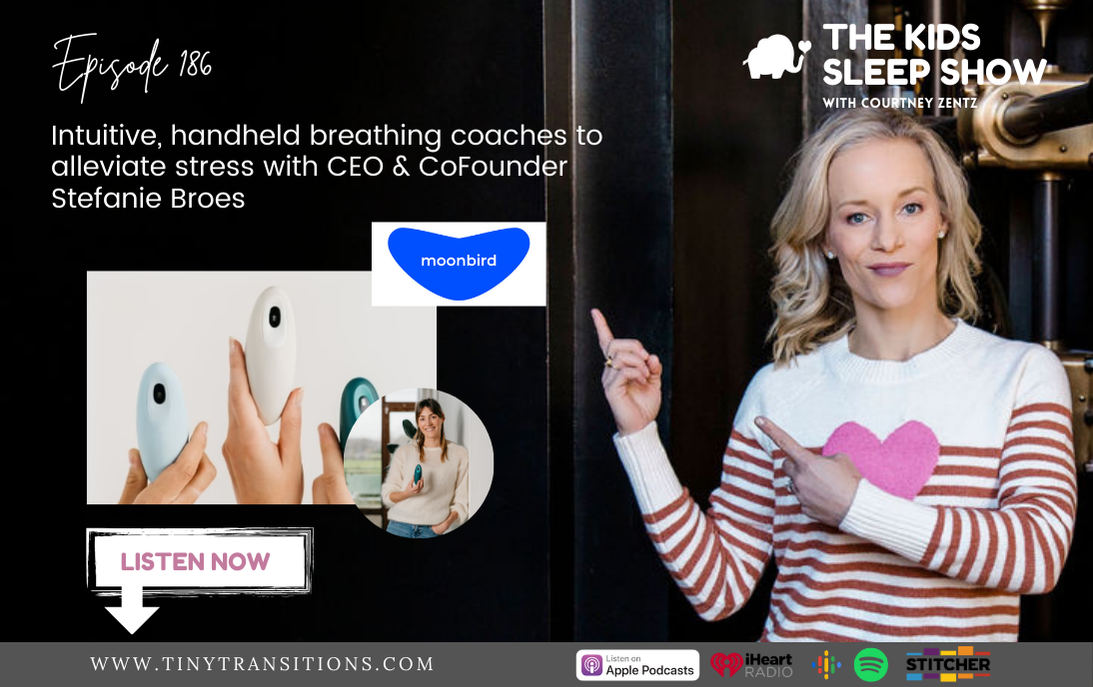
This week, I am welcoming Stefanie Broes, the co-founder of Moonbird, a health tech start-up active in the well-being space. Moonbird is the world’s first handheld breath pacer and is all about making breathwork accessible to let people live healthier and happier lives. The product is used to decrease stress, manage anxiety, and combat sleeping problems. Stefanie has a medical background, a PhD in pharmaceutical sciences, and a master’s in IP and data protection law. Before starting Moonbird she worked in two other start-up companies. When she discovered the effectiveness of breathing exercises to tackle her own sleeping issues, she submerged herself in the matter.
Moonbird originated in Belgium, as the brainchild of Stefanie and Michael Broes, a brother and sister duo. When Stefanie suffered from sleeping problems, she tried breathwork but struggled to keep her focus on the breath. Moonbird is based on the calming power of affective touch. This refers to the slow, soft physical contact that, as social mammals, we’re pre-wired to find soothing. This revolutionary tool guides you intuitively, helping you to breathe slowly. Simply hold moonbird in your hand, and sync your breathing to the device: inhale when it expands, exhale when it deflates.
Episode Highlights:
-
How Moonbird helps reduce stress & anxiety
-
Breathing techniques that improve sleep
-
Screen-free relaxation tools for kids & adults
Sleep Struggles Solved + Results Guaranteed
[xyz-ihs snippet=”Transcript-Start”]
Welcome to The Kids Sleep Show podcast, where we dive into the magical world of sleep and all things parenting. Join us as we embark on a journey filled with expert advice, practical tips, and heartwarming stories that will transform your little ones into sleep superheroes and empower you to navigate the beautiful chaos of parenting. I’m your host, Courtney Zents, and I’m on a mission to change how the world views sleep and provide accessible sleep coaching resources for all families to build healthy sleep habits in their home for children and adults of all ages. As an award winning speaker, author, and pediatric sleep expert, myself and my team of consultants work intimately with families around the world to teach healthy sleep habits to children and adults. I believe wholeheartedly that sleep is the foundation for which a happy home is built.
So let’s sleep together. Hey, everyone. Welcome to this week’s episode of the kids sleep show podcast. I’m your host, Courtney Zentz, and I am joined this week by the cofounder of an amazing new product I’m excited to tell you about today called Moonbird. So welcome, Stephanie Bruce.
You’re all the way over in Belgium. So take a minute and introduce Moonbird. Introduce yourself and tell us a little bit about this awesome product. Yeah. Thank you so much, Courtney.
First of all, thank you as well for having me on the podcast. I, I really love this format, and I love what you’re doing. And so for all the people listening, my name is Stephanie, and I am the cofounder of Moonbird. Moonbird is a company. We’re focused on health and well-being, specifically in the context of sleep as well, which is, I think, is really relevant for this audience.
And, we started the company around five years ago. We’re, founded in Europe, but we’re now also focusing on The US market. And, we develop products to help people to guide their breathing. So our mission really is to enable people or to create awareness around the fact that we, as humans, we breathe our whole lives long, but we usually don’t think too much about it. And we really wanna make sure that people understand that your breath actually is a really powerful tool that that can help you shift your your mindset, your mood, and impact your sleep as well.
And so we started the company a couple years ago because I used to deal with sleeping problems or issues pretty badly, when I was doing my PhD project. And, I discovered meditation techniques and then breath work ultimately, which is, like, similar to meditation, but it’s also very different in the sense that you change your breathing rate, which, you know, when you meditate, it just stays you focus on your breathing. You don’t really change it. But when you do breathing exercises, this, impacts your nervous system and it calms you down. And I found that so powerful, but I had issues with implementing the techniques.
Right? So I use different applications, and I love headspace and calm and so on. But, you know, when you’re having sleeping issues, you don’t wanna spend more time on an app in your bed, especially not in your bedroom. And that’s the moment that I I came to the realization. Like, I actually want to guide myself in a different way.
Like, I need a little bit of extra help, but I don’t wanna look at a screen, which is the moment that I I thought of using the sense of touch as a way to guide ourselves. And so Moon Buddy and Moonbird are are products are two physical products that expand and contract, and they give you a pace that you need to match with your breathing. And so it makes this whole, exercise or the experience to do breathing and practice, breathing exercises much more intuitive because you literally rest your attention on the device. You breathe in and out mimicking the rhythm of the Moonbird or the Moonbirdie, and this then, yeah, really, like, calms your nervous system down, which then makes it easier for you to fall asleep. Which I absolutely love because I will tell you, I just got the products before we recorded this podcast, and I was excited to go away.
It was my daughter’s, as I was telling you, Irish dance for national championships. And the world of Irish dance is something I was not prepared for when, my daughter started to get really, good at it. And, the sense of anxiety and and stress in these kids is kind of a lot. My daughter doesn’t seem to notice it as much as some of the older kids that are that are doing it. So she has a really good sort of balance on her nerves.
But I will tell you, we took the Moonbird and the Moon Buddy with us. And I’m a huge non device person, I don’t want my kids on those screens in bed at 2AM trying to find a meditation or something to put on. If they’re struggling to go back to sleep, I think it’s counterproductive in what we’re trying to do with removing some of that stimulation. And so I took both the Moonbird and the Moon Buddy. And it was so easy to just grab it, especially right before she was dancing.
And she sat and she’s really getting into the meditation to your point. She has like a specific Irish dance meditation, and then the breath work. And to watch your kids physically calm when they’re doing something, especially with a device like this, as a parent, I have to tell you is like really cool. So it was a neat experience just in, you know, just getting them before we left and then watching as she sat with her eyes closed on her little yoga mat in this crowded super busy hall with earbuds in that didn’t have anything on. But just to kind of block out the noise, and she just sat and did the breath.
And it was, really a cool experience. And, you know, for folks that are watching this versus listening, like, the device is handheld. You know, my daughter is nine, so she has the moon buddy, And then we have the moon bird, but you know, you can use both. So maybe take a minute to talk about Stephanie, the difference in the devices, because as somebody who’s like, literally just got them and just use them and was like, this is so awesome. Like, tell us about the difference in the two because I know the moon buddy has a little bit of a noise of calm with it, which I thought was a a neat, add on that’s a little different than the the Moonbird.
Yeah. Indeed. So we actually started with the adult device because that’s you know, the inception of the idea really came from from ourselves, to solve our own our own problem or needs. And the shape is actually based on the shape of an avocado. So when we were trying all these different, shapes, we were we were trying we wanted something organic, and we had a fruit basket in front of us.
And so we had an avocado. We had a pear. We had a lemon and so on, and then ultimately, it was an avocado that fitted the the palm of our hand the best. So it looks like an avocado. There is a sensor incorporated as well.
So if you want, you can optionally connect it to an application and get biofeedback, and see how your heart rate and heart rate variability response while you’re doing an a breathing exercise. And that’s for those people, you know, who need a little bit of extra convincing to really see, not only feel, but also see that breathing has an immediate impact on your body. So that’s, like, more of the science, that that’s connected to the to the adult moonbird. And the, adult one has two wings that expand and contract in the palm of your hand. So you literally just wake the device by shaking it.
So there are no button as well, on the device, which is also done very intentionally because we didn’t want people who have sleeping issues, you know, to think of, oh, I need to turn this off after using it or something. So it just starts very intuitively by shaking it, then the wings start to expand and contract and you breathe with it. And then after a couple of minutes, it’s it just shuts off automatically. So you don’t even need to remember how to turn it off. And that was put on the market.
And after a couple of months, we started getting this feedback from from parents actually saying, I bought this Moonbird for myself. And, you know, the concept is so easy, that I explained it to my kids who were curious about it, and they actually started grabbing it as well when I was not around or not really looking at it, and they started breathing as well with the device. And so for kids, the story was, like, this is a small bird, and it’s breeding in your hand, and you need to mimic it when the belly of the bird gets bigger. You know, your belly gets bigger and so on. As their children, apparently, they really this story really resonated with them.
And so parents then gave a feedback to me. Like, it’s crazy. Like, I I don’t find any good solutions to bring my kids, to to make them more calm, instead of putting them in front of the screen, or something. But I that’s actually not what I want, which is exactly to your point. And this device does exactly that.
So that’s when it, like, clicked as well, and we were like, this is a great screen free relaxation tool for kids as well. But the Moonbird for adults was a bit overengineered because you got this sensor incorporated, and then you can connect to you can connect it to an an application and so on. And that’s when we said, like, let let’s remove it from all those additional features, and let’s create a device specifically geared towards skits. So those are the moon buddies. We’ve got two.
One is BB the bird and Barry the bear. And these are, just it’s the same principle, but it’s stripped down from all the additional features. Features. So it has this belly that expands and contracts. It works a little bit different because there’s an airbag in here instead of, like, two wings expanding and contracting.
Has this airbag that expands, and then you’ve got these nice little covers as well. So you can choose between the bird or the bear, and you can swap between them. And we wanna launch much more, animals that children can really personalize it. And that’s basically it’s there are four, breathing exercises stored on the device. So we slightly, recommend different breathing exercises for children who have a different age, but it’s up to the child as well to, like, experience a little bit what breathing rhythm they find, pleasant and and and nice to breathe with.
But, yeah, those are the two most, yeah, those are the the the main differences between the two devices. Well, I love it. My son actually the night we got the Moon Buddy, he’s very much into calm, and he’s a very calm, docile kid, you know, and, he had a nightmare. And I am not someone who’s used to a child coming into my bedroom. My kids have always slept well.
But as a parent, one of my main rules is I’m always accessible. Right? Like, so my kids, I could say, maybe in the past few years have come into our bedroom five times. That’s it, you know, across the years because they just they sleep well, you know, but if they’re sick or they have a stomachache or flu or something, right, like, they come get us fine. And, my son came in and sick, mommy had a nightmare.
And I’m like, woah. You know? And you kinda catch me off guard given my my day job where I’m like, wait. What? I’m no.
I’m sleeping. Like, you know, so it takes me a second. And I went, you know, went over to his room. And I always say to to the families that we work with from a sleep consulting standpoint, be accessible, not excessive in your response. Right?
Because I think sometimes parents get far too excessive, and then they’re like, okay. Well, let’s do all these things. Then all of a sudden, the child, depending on their age and ability to sort of understand, goes, oh, wait a minute. So if I correlate that x y z happens, and then I get this and this and this and this, this is how like you start these habits that parents don’t necessarily want or that come to us and go, hey, like we, you know, we gotta dial things back because bedtime and overnights are just a mess now. Right?
So my son came in, and he was not feeling his best at that moment. It was the middle of the night. And we went back to his room and, had the moon buddy. And he is someone who gravitates to that type of stuff. He’s very good with his breath.
And he instantly was like, I love it. I think to your point, the fact that it’s a design shaped for children. Right? There’s recognition. And he’s like, well, what does it do?
And I’m like, okay, buddy. Like, let’s just lay back down. We’ll turn the light on. I had the light on, like, really low near his bed. I have a nightlight, and he sleeps with an eye mask on.
And, like, just close your eyes. Like, we’ll hit the little button. It was super simple. Turn it on. It turned green.
And he laid there and fell back to sleep. And I sat in there with him until he fell back to sleep, but I’m always very balanced. You know? Stephanie, as someone who does this, like, if you lay there and then you rub his back and then you end up sleeping in there, and then the next night they come in, they’re like, I had a nightmare again. I’m like, did you have a nightmare again?
Or did you just want me to come in and rub your back? You know? So Yeah. Oh, again, like accessible but not excessive. Right?
And I say that and I always get 9,000,000 emails that are like, you’re, you know, you’re mean. Kids need to be nourished. I’m like, I nourished, but not too much. Yeah. Yeah.
Instantly, like, gravitated to it. And then when we packed for the trip, he, like, grabbed it, and he grabbed his little Boppy, which he’s had since he was a baby. And he travels with that in his Naturepedic pillow. He’s my bougie sleeper, which, annoyingly, we left in the hotel yesterday. But, you know, but it was just so comforting for me to see as a parent.
He was about four years old when I found out I had stomach cancer, and I had to have my stomach removed. And he instantly went to, like, is mommy gonna die? And he would sleep on the stairs, and we would find him when we were in the living room, like, watching TV, sleeping on the stairs, and he wouldn’t tell us, but he would come back down after I put him in bed so he could hear me still talking. And as a parent, it is heartbreaking because we would come over to go to bed and we’re like, like, gosh, you know, and it’s like, how do we manage this? And it was hard, honestly, because you’re trying to like help a kid know that his mom’s not gonna die.
But you know, he’s four. And so we started with breath work and meditations with him, and it worked beautifully. So this is like a natural progression. He’s 11 now, I’m fine. But that meditation, like, they’ve always had, you know, I yelled at him once for playing kickball too late.
I’m like, guys, it’s 09:00. And I’m like a, you know, a little bit of a ninja about bed. And my kids are running across the front yard going, use your breath, you know? So it was kind of, that sort of moment where you’re like, okay. Well, at least they get it, you know, and that was a couple years ago.
But a product like this is so cool because it’s not screens. Like, blue light is such a stimulant. And I talk to people so much about that. I’m like, get an old school alarm clock. You do not need it next to your bed.
You can if it’s an emergency where you have someone who’s aging or a kid that’s out, fine. Put it across the room. Like, it doesn’t need to be that device that is your alarm clock. They’re $5 at the store, you know, pick up an alarm clock. Because if you start to disassociate some of those screens and the devices and the immediate response to like blue light stimulation, right, it, it stimulates the amygdala and prefrontal cortex, and it just causes you taking so much longer to then calm back down to go to sleep.
And and a device like this, like, my son turned it on. The little green light came on, and he laid there, closed his eyes, put his eye mask back on, and fell back to sleep. And it was just that to your point, that little sort of soft air compression. And it was really it was really just cool. Again, as a parent, not only as someone who has this podcast to see the product actually working in a situation where timely wise, he had a nightmare and he could, you know, he could leverage it, which was really great.
Yeah. Well, thank you for mentioning that, because I you didn’t tell me that before, and I really love that. And that’s you know, that we actually combine two things if you look at it from, like, a neurologic and a physiological perspective. So it’s like a sense of touch in itself is a very soothing way of communicating information. It’s why children have a teddy bear.
It’s why we as adults hug each other. And so we use a sense of touch, and so that’s comforting in itself. Like, holding something thing gives you, like, security. It makes you feel to be not alone. And then at the same time, you’ve got this this breath guidance, which, if you follow it, you know, that, relaxes your nervous system.
It really calms you down. It activates the parasympathetic nervous system, and that, like, unwinds you as well, making your body, enter a restful state, making it easier for you to fall asleep. And so it’s basically those two, things from a science or a biological perspective that we combine that work like magic for a lot of people. And the the nice thing about it is that we’re also giving Moon Buddies, for free to schools, in in certain projects. Like, schools can apply for them, and then they can request a couple of them.
And so we get feedback as well from that perspective and that angle. And that’s also what we hear from schools is that it’s a great way for children to self regulate, and they don’t need otherwise, when a child is overstimulating in the classroom, what often happens is that they leave the classroom and they need somebody to help them co regulate and calm down. But when they have access to these kind of tools, they can stay in the classroom and they can learn to self regulate. And that’s really nice, I think, about this because especially now in the in the school context as well. They don’t need to skip class.
They don’t need to leave class and so on. And, ultimately, they’ll learn to understand, you know, I can really use my breath as a tool to calm myself down, to steer my emotions, to steer how I feel, how I sleep, and so on. And that’s that’s really the the mission with Moonbird at large that we wanna we wanna we that we really wanna enable people to use their breath as a tool, providing them the tools to do that and to tap into those benefits. Well and I think it’s it’s flexible. Right?
It’s soft, so it’s really comfy, which is cool because they’re both very soft, but it’s the flexibility of it that I think is, like, put it in your book bag, take it with you to dance, you can have it on the school bus, you know, when you’re in the car and you need a minute, like, do your breath work. You know, sometimes my kids will, you know, have have a minute, which we all do as parents. And I’m like, no, we need a meditation. We’re doing a gratitude meditation, because this is crazy. You know, you guys are, you guys are crazy down right now.
And I think sometimes in the moment, it’s nice to pause and show the power of your breath. I am someone who struggles very deeply with sitting for a meditation, either without a being guided or just to sit still, honestly, I just I have like squirrel brain. And so when I focus on my breath, or I focus on something that is short, usually like ten minutes or less, I can do it without a problem. And I find that it brings me back to like, to your point this center of, wow, you know, even after just ten minutes or just falling asleep at night, you know, it’s sometimes so nice to just lay and use that breath, and then you’re focusing on the one thing. If I try to do like, again, some of the apps that are out there are great, but their apps, to your point, our phones don’t come upstairs.
If you need me, call 911, and the hospital’s gonna do what they can for you. You know? My kids are still home, so I don’t have to worry about them being out and about. But I’m like, you know, if if something happens, then I’ll find out about it at 05:00 in the morning. I’m sure that tuneal changes my parents.
Well, my mom’s already dead, but my dad when he is rapidly aging. But, like, the the hospital is gonna do what they need to do, and I’ll get there as soon as I can, you know, and I try to be balanced with keeping that device out to a degree. I think, you know, everybody has situations where they need the phone in the room, but, like, keeping it across and using this instead of putting on an app, you know, and I just think, you know, we need a better sense of how strong the power of breath work is. I think companies even can leverage you know, I often think, like, people are back to office. Right?
A lot of people here in The States are going back into the office. And sometimes it’s hard, you’re in a cubicle. And I used to hear the guy next to me, like clipping his nails. And I’m like, oh, like, such a like, gross, sometimes environment, you know, depending on the people we, you know, we’re near. And sometimes it can be hard to kinda regulate in that environment.
And I always think, like, gosh, they just need, like, a little pod that has four chairs with, like, four moon buddies sitting on them that are attached, so nobody sticks it in their pocket, you know. And just having a space that has, like, the sound of spa, and it’s dark, and they can go in and take five minutes and go, okay. I’m out of here now. You know what I mean? And I think, like, classrooms can benefit from that.
I think sports teams can benefit from that. And and the power of that meditation and breath work, like, across the, you know, across the gamut of children and adults and, frankly, even older folks. You know? I mean, I think there’s just such a power in it. Yeah.
It’s so it’s unbelievable, actually, once you, like, start to explore the world of breath, how versatile and how broad it is. And, yeah. Thank you for mentioning that because it’s interesting. We’re actually doing two research projects right now with, major football clubs in, in Belgium to illustrate the importance of breath work in a scope of, you know, sleep as well, which obviously, does a lot for your recovery, and that then helps a lot when you when you’re doing, like, high intensity sports and so on. So it’s like everything’s connected, and stress in itself, like, is a source of so many negative things and aggravates so many diseases.
And we’re not we’re not a medical device. Like, we don’t wanna claim that we solve, like, any diseases or anything, but stress is linked to so many diseases. And if you change your stress or end your sleep as well, if you can improve, your sleep, you lower your stress, those things, they impact the rest of your life. Like so start by changing your breathing, and you’ll be able to lower your stress. You’ll be able to sleep better.
And so many other things in the rest of your life will just fall into place. And whether that’s in relation to sports or focus in on in in your on your job or in a classroom or dealing with anxiety or dealing with, you know, so many other things. I I it’s so all related, and it’s just really I find it just, like, I would say breathtaking, not breathtaking, no pun intended, but, like, yeah, amazing how broad this whole world is of of breath work and how powerful it is. Yeah. Well, I’m glad you could come on to the show today to talk about it because I think even new moms, middle of the night, you’re awake.
And maybe you’re nursing your baby and you’re just like, oh my gosh. I’m overstimulated or they won’t go back to bed or something’s happening or we just did a bottle and now they’re upset or not have to sit here for three hours. Right? Those are realities of having a new, you know, a new baby. And even sometimes just in the middle of the night, if a mom is pumping, for example.
Right? What are they doing? Most people are called the doom scroll, and they sit at 2AM, and they do this for twenty minutes. Well, then you’re firing your brain up, and then you try to go back to bed because you need to sleep since the baby’s not sleeping. Right?
And then you can’t go back to bed. I know sometimes I do late things live on TV with, like, different, you know, Pinterest lives, and they’re on the West Coast. So I gotta be, like, on my game at 07:00 at night or 10:00 at night. And I’m like, I can’t. I’m in bed an hour ago.
And then it takes me an hour to, like, lay in bed at eleven now and go, oh, like, I gotta go to bed, but I’m so overstimulated from the lights and the cameras and stuff. And I think it can be hard. I feel like something like this is an easy way to, again, just reset that, you know, that expectation. I I say all the time, sleep is the foundation for which the house is built. You know, if you built a house on rocks, your foundation is unstable.
And then when a windstorm comes in, your house falls down, you know, and so people are so concerned about how big the house is or how many walls they have. It’s like, well, buddy, if you don’t if you don’t pour that foundation properly, your whole house is gonna crumble. And I think sleep is that foundation, you know, that needs to be solid and sturdy and strong. Absolutely. And you have to feed the right things for it.
You know, I talk a lot with my brother who also had the stomach cancer. We both have had our stomachs removed. It’s a genetic cancer. And, you know, we both had different recoveries and and for a variety of reasons. But sometimes, he’s now seeing like, oh, you know, so for my birthday, which was yesterday, he sent me beet powder.
And he’s like, Oh, this is supposed to be amazing. And he’s drinking like turmeric lattes, which if you knew my brother ten years ago, it was not a thing. It’s funny, because it’s just neat to see. I think when people have the moment about whatever situation in their life is impacted, right? And they recognize that there are things they can control a lot of the adults that we work with in our practice here, they’re not clinical sleep issues.
They’re habits, put your phone down, go to the gym, maybe don’t drink five beers every night. You know? And some of them are choices and to each their own on their lifestyle is fine. But I think when you start to realize the impact of the compound of all of these things and not taking a moment to look back and go, your body is this fluid living beautiful thing and you it sort of responds to how you treat it, like, and breath is something you’re doing. I mean, I don’t know the statistics.
You probably do for how many breaths you take your entire life. But, you know, if you think about that, it’s like, oh my gosh. If I was more mindful of that in these moments where it’s like, I’m up in the middle of the night, and I need to just kinda get a sense of calm, but I also need my mind to not be traveling or focused on TikToks or whatever. You know? Mhmm.
I think it’s it’s such a powerful thing. Yeah. No. Absolutely. I couldn’t agree more.
And, first of all, happy belated birthday. Thank you. But, no. It’s absolutely true. Like, we we we vastly underestimate how powerful it is.
Yeah. And we’re we’re here to change that, and I hope you know, we’re we’re we’re doing that, little by little. So in Europe, we’ve already sold 60,000 devices and units. So in my mind, that’s, like, 60,000 people and lives that we’ve impacted for the better just by making people aware of the fact that they can breathe and by that change so many things. And, we just actually recently just launched the Moon Buddy, so that’s, like, a whole new market for us that’s opening up.
And it’s just it’s so heartwarming to see the feedback of, like, children and parents coming in, parents who struggle with their kids and their sleep and so on. And it’s, it’s a very nice space to be in and to feel that you’re, like, doing a very important thing with something so simple as breathing. Right? Because that’s also, like, it just blows my mind to say, like, yeah. If you just change your breathing rate or if you’re aware of the fact how you’re breathing or you could impact that, it will change so many things.
And that’s it’s it’s so simple that it’s it’s amazing. Yeah. Yeah. I love it. Well, tell people where can they find you.
I know you’re on social. You’re just getting into The US market. So tell us a little bit about where to find Moonbird and Moon Buddy. Yes. You can find out, more on our website, which is www.moonbird.life.
And on our Instagram page as well, moonbird.life, we try to post lots of interesting insights and tips and stuff about, you know, new product releases and so on. We actually today have a new scientific paper that was just released where we evaluated a vibration based, device versus a motion based device like Moonbird, so that expands and contracts, giving you a pace that you need to match with your breathing versus, like, vibrations which, you know, is using Apple Watch or the Fitbits and so on because, obviously, there are lots of, devices, you know, guiding your breath. And, in that paper, we saw, like, there is a huge both on a subjective, but also on a objective, level, a huge preference for the the pressure based or the motion based guidance, which, you know, what we have been feeling intuitive and have been seeing and experienced for the past five years, we’re like we’re now, like, building the evidence to really support that that users really prefer that kind of, like, very soothing and comforting way of having their breath being guided. So things like that and much more, you can find on our socials. I love it.
Thank you so much. I appreciate you, Stephanie. I’m so glad we could do this and, look forward to sharing all about Moonbird and Moonbuddy because I think these products are awesome. So thanks for tuning in, and thanks everybody for watching or listening to the Kids Sleep Show podcast. Yeah.
Thank you. Absolutely. Thank you also, Courtney, for inviting me. Thank you. Bye.
You’re welcome. Alright. One more thing before you go. Don’t forget to subscribe, leave a review, or share this episode with someone you know who could use a little more sleep in their life. For tips and resources, be sure to visit us at tinytransitions.com or follow us across social media.
Here’s to better sleep, brighter day, and healthier day life.
[xyz-ihs snippet=”Transcript-End”]