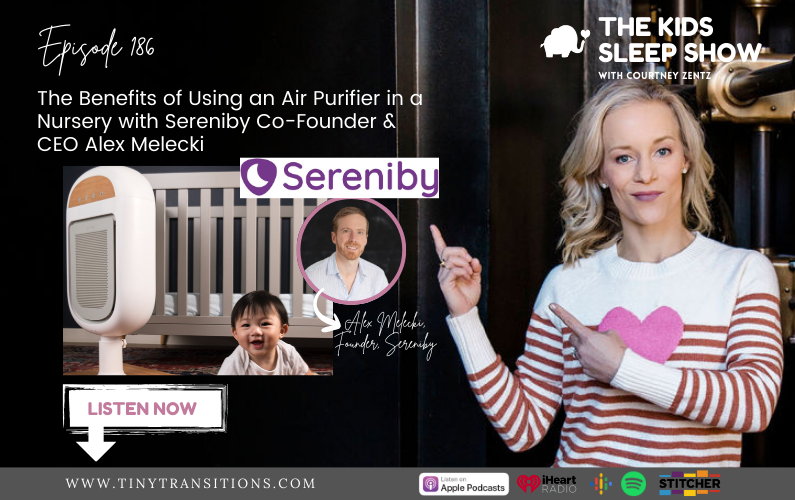
When it comes to creating the best nursery and sleep environment for your little one, most parents think about blackout curtains, white noise, and cozy sleep sacks. But there’s one element of the nursery that often gets overlooked, and it can have a big impact on your baby’s health and sleep quality: the air they breathe.
In this week’s episode of The Kids Sleep Show, I sat down with Alex Melecki, Co-Founder and CEO of Sereniby, to talk about the powerful benefits of using an air purifier in your nursery. From reducing allergens and airborne irritants to supporting deeper, more restful sleep, an air purifier can be a simple yet transformative addition to your child’s sleep space.
If you’ve ever wondered whether an air purifier is worth it or how to choose the right one, this conversation will give you the answers and peace of mind you’re looking for.
About Our Guest: Alex Melecki is the Co-Founder and CEO of Sereniby, a wellness technology company dedicated to providing babies with the clean air they need for a safer, healthier start. Before founding Sereniby, Alex spent his career as a strategy consultant helping Fortune 500 companies build and launch new products. He and his wife, Lexi, a pediatric nurse, began thinking differently about the role of indoor air in health and safety as they prepared for the arrival of their first child.
With Lexi’s background in pediatric health, Alex’s expertise in product development, and their shared experience as new parents, they quickly realized how overlooked indoor air quality is in conversations about infant wellness—and how limited the available products were for helping parents create the right environment at home. That insight sparked a new path: Alex left consulting, and together they spent nearly two years building the product they wished had existed for their own nursery—a purpose-designed air purifier and monitor, built from the ground up for the needs of babies and their parents. Along the way, they welcomed their second child, a son who became the first baby to ever have a Sereniby in his nursery.
Alex and Lexi live in Philadelphia, along with their two young children and their neurotic but lovable miniature poodle.
Episode Highlights:
- Do I need an air purifier for a baby?
- What features do you look for in an air purifier for a nursery?
- Are air purifiers safe for a baby’s nursery?
Sleep Struggles Solved + Results Guaranteed
[xyz-ihs snippet=”Transcript-Start”]
Welcome to the Kid Sleep Show podcast, where we dive into the magical world of sleep and all things parenting. Join us as we embark on a journey filled with expert advice, practical tips, and heartwarming stories that will transform your little ones into sleep superheroes and empower you to navigate the beautiful chaos of parenting. I’m your host, Courtney Zents, and I’m on a mission to change how the world views sleep and provide accessible sleep coaching resources for all families to build healthy sleep habits in their home for children and adults of all ages.
As an award-winning speaker, author, and pediatric sleep expert, myself and my team of consultants work intimately with families around the world to teach healthy sleep habits to children and adults. I believe wholeheartedly that sleep is the foundation for which a happy home is built. So let’s sleep together.
Hey, everyone. Welcome to this week’s episode of the Kid Sleep Show podcast. I’m joined this week by the founder and CEO of Serenity, Mr. Alex Malecki.
Welcome from Philly. I’m so excited to be talking to somebody who is just about six miles away, which is good. Welcome to the show, Alex.
Thanks so much for coming on today. So excited to be here and always great to meet folks in the baby space in Philadelphia. So tell me a little bit about Serenity.
You and your wife co-founded this product about two, two and a half years ago. I know there’s been a lot of R&D time and you guys are just hitting the market now. Tell us about your journey, how you got started with Serenity, what it is, and let’s dive in.
Yeah, that’s great. And so maybe as a way to do that, you’ll indulge me in sharing a bit of my personal journey. And I promise the dots will connect back to the business, but I think it’s important to kind of dovetail those together.
So in 2015, I was just out of business school. I was working in management consulting in a consumer tech focused role, basically consulting for big companies on how to build and deploy products to customers across the country. And I met my wife, my now wife, Lexi, who’s a pediatric nurse at CHOP, Children’s Hospital of Philadelphia, and got married in 2019, found out we were expecting our daughter in 2020 and COVID baby.
And like all first time parents, we’re trying to do the right things for prep. So you’re setting up the nursery or just reading everything you can find on how to create a safe environment for the baby, how to give her the best start in life, how to create an environment that’s as welcoming for her to come home to. And through that process, there were a couple of insights that I’d say bubbled up to both of us.
One, and I think this will come as absolutely no surprise to you or anyone who follows your content, but babies just sleep a huge proportion of the time. Maybe not always for extended periods, but they spend a huge proportion of their time sleeping. And very much of that is spent indoors.
And indoor air can be incredibly dirty. So there’s some research that suggests it can be two to five times more polluted than outdoor air. And we can talk a bit more about why that is later.
But so that’s number one. The second insight was, well, I’d say it wasn’t the type of thing that was on every single parenting blog at the time. There’s actually a massive amount of really rigorous scientific research that links air quality in early childhood with both immediate and lifelong health benefits.
So things like stronger lungs, lower rates of asthma, better brain development, lifelong metabolic health benefits, and then immediate benefits on sleep quality. So fewer allergens in the air means less coughing, your baby’s waking up less. And then third, air circulation.
So something that my wife likes, who’s very focused on was air circulation as a safe sleep mechanism. Something that they talk a lot about at Children’s Hospital. And so there’s actually some good research that suggests that having a fan in a baby’s nursery can reduce the risk of SIDS by 70%.
And so we’re like, well, we should probably go out and buy whatever, like every baby product out there in the world exists. Like we should probably go out and buy the air purifying fan that we’re supposed to buy to circulate and purify the air in our daughter’s nursery. And that just didn’t exist.
We looked everywhere. So we went through a whole process where we ended up, should we get a ceiling fan installed? Should we get this floor fan to circulate the air? These things might make the air quality worse. Like should we buy an air purifier? And so we bought our first air purifier.
We ended up getting a floor fan. And it was just a terrible experience. Honestly, as a person who designs products for a living, it was too many different things to turn on and off.
Like the floor fan kept tipping over as soon as our daughter was able to crawl over to it and knock it over. The air purifier, I couldn’t tell if it was doing anything. And so it just felt like something that we could do better.
I love that. And I think to your point, how do you look at a situation and go, there’s a gap in the market. And I think with your experience, you actually are able to do something about it, which is beautiful.
I mean, having from Lexi’s perspective, as a pediatric nurse and in the work we do here from a sleep consulting standpoint, safe sleep for me is something that is a huge foundation of what we do. And there’s a lot of education that we provide to parents because they just don’t get it. And you don’t always know, or I think we assume in some cases that people understand what safe sleep guidelines are.
And I think that’s not necessarily the case, not just here in Philly, but really anywhere. I mean, I think there’s just this general assumption, people know not to put a baby down on their belly. I think that when you talk about the air circulation and certainly some things, I’ll pull some of these studies and put them in the show notes, because I think it’s valuable for people to understand the true medical side of this, which I think Lexi brings to the table for you, which is really cool, is the air circulation, the purity of what you’re using in these products, when you’re designing something like Serenity, that was forefront of mind, obviously around safe sleep and SIDS reduction.
I mean, that’s something every parent fears. And I think sometimes we were just talking about wearables, and I think these products are all designed in different ways, these wearable devices. And I think there’s an aspect that actually can make the environment a bit more anxious and scare filled.
So I want to take it back to like you’re looking at your Pinterest board, right? And you’re just sitting there going, all right, well, what we’ve got right now is not working. And if we’re going to expect another one, we want to do this different and better, right? So you go to the drawing board and you say, okay, well, we had two devices, right? Now you got to buy two products. One’s not working because as soon as she starts knocking things over, that’s a done deal, right? And so you started to map out like, hey, there’s a gap in the market, right? The air quality, especially during COVID, I think air quality was on top of mind for everybody.
You started to innovate. And what was the most surprising thing, I think, in the innovation for you and Lexi that you found as you were doing the research and reading the studies about just the impact of air quality as some of the things you’ve already mentioned, but just like what was the most, I would say, oh my gosh, eye-opening moment for you? You know, I have to say, like, let me just talk about a little bit about the air purifier that we got for our room. And then I’ll connect, because we bought this air purifier off of Amazon.
It was the first air purifier we ever owned. And the thing that really bothered me was that we had read this long paper from the World Health Organization that summarizes all the research on air quality. And it gives a really specific set of standards for how clean the air should be for everyone.
So there’s a threshold of the air is supposed to have fewer than five micrograms per cubic meter of PM2.5 particles. So it sounds very scientific and metrics-y, but basically a cubic meter is about the size of a baby’s crib. And a PM2.5 particle, these are the particles that scientists worry the most about because when you breathe them in, they can go through your lungs and into your bloodstream and have health impacts.
So you’re basically talking about a particle that is an invisible floating speck of in the air. And you can have fewer than five, basically five of those in the space of a baby’s crib. So it’s like very rigorous threshold.
And we got this air purifier and it did have, supposedly it did have an air quality monitor on it, but it would just turn red, yellow, and green. And I had no idea how this linked to the WHO recommendations. So it’s like, is green less than five? How did they link this to that? And so I ended up buying a portable air quality monitor and walking around with it just because I’m a really weird and eccentric person and measuring the air quality in our house in different rooms and just how varied the air quality is in different rooms of your house at different times.
And by far the worst room in our house, and this is not unscientific, but by far the worst room in our house was our daughter’s nursery. And I have some hypotheses on why that might be, but it was really interesting to see that, at least in our case, there were some specific factors I think in the nursery that made the air quality worse than the rest of the house, which was already, didn’t have the best air quality to begin with. That’s so interesting.
I’m just making a note like buy air quality monitor, because now you have me thinking like, I’m going to monitor the air quality in our house and just see like what, because we have an air purifier in the living room we got during COVID, but now I’m just so curious, like, it’s not red, yellow, green, but it’s pretty much equally as generic as that. So we might be one of your first customers as you roll out. And I think that one of the things that we did when we were designing Serenity, our product was, it was really important to me to have an air quality monitor built in that was scientifically precise.
And that could, if there’s a WHO recommendation on air quality, I want to know if our daughter’s air, our son’s air is meeting that recommendation on air quality. And if it’s not, I want the purifier to kick in and rapidly clean the air so it gets back to that recommended safe level. And the problem that I found with basically, I would say, I don’t want to make a universal generalization, but the vast, vast majority of air purifiers, aside from the highest end ones, is that they use cheap air quality sensors in them.
And that’s part of why they have the red, yellow, green calibration. And they’re also 99% of air purifiers are manufactured in China. And air quality there is substantially worse than it is here.
And so they don’t think about it the same way. They don’t think about like, you know, this needs to be, you know, less than five micrograms of PM 2.5. That would be like unheard of clean for them. So you just can’t calibrate to the same level.
And for us, like getting that precision calibration using the most expensive, best sensor, spending months on calibrating it and the way our product worked, it was very, very important to me because like that data is important as a parent. You want to make sure that your kid’s environment is pristine. Well, and I think as parents, right, like putting, I had like my parent hat and then my like pediatric sleep expert hat, right.
You know, putting on the parent hat as somebody who was like inexperienced with our first kid, right. We were kind of joking before we started talking, like I went into babies or us, it was still a thing at the time. And I remember just like grabbing a two-stage mattress and be like, that one’s 250.
Cool. And just whack it with the gun and being like, and we’re done, you know? And I should say laser gun, you know, for transcription purposes, right. But like, you know, you kind of just went around the store and we’re like, beep, this monitor looks good.
Beep. This mattress looks good. Like I didn’t understand off-gassing from a mattress.
I didn’t have any idea what that was till I started working as a sleep expert for Naturepedic and starting to learn like, oh my gosh, like all of these baby products have so much stuff in the mattresses, especially are toxic. Right. And people don’t know that, like, you don’t know that going into having a kid, like you’re just trying to figure out like, okay, is it maybe growing good? And you know, or do I have cankles? You know, like you’re not like, I didn’t have a lot of time or frankly, just, I didn’t understand that I needed to look at these things because you don’t see the air, you don’t see the off-gassing from a baby’s mattress.
And they’re going to sleep on that for five years. They’re going to be in that room for 18 years, unless they’re like my sister-in-law who stayed until she was like 30, you know, but it’s a Debbie’s listing. I’m sorry.
But, but yeah, so it’s just like there, I think it’s the invisible, the invisible load child’s body that, that people don’t see. And I’m like, so appreciative of the fact that you take the science and the research and it’s not just like, you know, the cheapest air calibration system. It’s like, I’m going to pay for quality when I know that it’s going to impact my overall health.
Like I do a lot for it with my, my own body, because I want to live and I have longevity goals. Right. And I treat my body, you know, in that way.
And I think we all want the same for our kids too, you know? Yeah. A hundred percent. A hundred percent.
I think that’s exactly right. Tell me about, you have the model, you did a soft launch in November, 2024. So yeah, I mean, it’s not quite up on a year, but how’s it going? I mean, so I’d say like we spent, you were saying this before, but, but there was a lot of R and D you know, I when I, when I quit my job to pursue this full-time back in mid 2023, I was a little bit cocky, I would say about how quickly I could build something like this.
Yeah. I’ve done it many, many times before, always with a pretty substantial team around me. And I was like, oh, you know, I can, I can make this move quickly.
And like, and it, it took longer than expected to get things exactly right. And part of that was we had our second in April of 2024. And so we started using prototypes of the product in his nursery.
And that just pointed out every single thing that was wrong with it. And, you know, it’s like you were saying with your kids, like you have the highest standard for things. And, and when we’re, when we’re using the product in our son’s nursery, we’d say, you know, actually the calibration of this seems a little bit off or like, you know, should we worry about it tipping over? Like, do we need to expand the base and add these like anti-tip mechanisms onto it? And you know, is, is, you know, oh man, we actually need to reprogram it so we can turn off all the lights on it.
You know, it needs to have a dark mode for sleep so that you can actually sleep in darkness and, and all of these things. And, and, you know, when you’re building a product there’s a physical product, all of those changes take time. So, so we took the time to get it right.
We went through tons and tons of rigorous third-party testing before November. And then part of what I, as a, as a person who’s done a lot of product development deployment work before, would always tell clients is you have to test this at small scale in the wild before really trying to scale it. And that’s, that’s the advice we followed here too.
So we, we started in November of last year, we started taking sales through our website. I think for all intents and purposes, anyone who is a customer of ours probably had no idea that we, we weren’t really marketing heavily across the country, but, but we were sending it out and we were talking to customers after they bought it and, you know, just making sure that everything was a good experience, that the setup was a good experience. I was, I was personally calling a lot of people, you know, so thanks to everyone who answered me and actually, you know, had a good conversation.
It’s been really fun to meet parents across the country this way. But, you know, I ended up making some, some very small tweaks to, to the setup experience. You know, so we made a tweak to add an insert to the packaging to, with a few more instructions and things like that, just to make sure that everything works, works as well as possible.
And as clear, as clear as possible, because I think as a, as a parent, like having, having gone through the new parent phase and still sort of being in the, in the thick of it, you just have so little time and, and you can’t deal with all these, there’s so many products to assemble and set up. And I feel like, you know, it’s like, as at least in our family, that that’s the dad role is like the set, you know, set up the new product role. And so, you know, I think as a, as a dad who set up a lot of products, I wanted to make sure the experience is good.
And like, we have the level of service needed for, for folks who have confusion and, you know, or, or need, need help with it. And I love the dark mode because I’m the person at the hotel that brings my daughter does dance. So she has tape anyway, like I’m always in her bag because they have to tape their hard shoes.
But that being said, we always have electric tape on us. And I’m like, go around and tape all the blue lights and these dumb things because in three in the morning, the hotel rooms are lit up like Christmas trees. So I appreciate the dark mode.
Cause in my kids’ bedrooms, I’m like, this gets taped, that gets taped. You can only see the first number on the clock, you know, because it’s bright. Like those, those things, when your eyes adjust at three in the morning, like it changes the environment a bit, you know, a hundred percent in a baby’s room to one of the things that we had from the beginning and then required a bunch of tweaking to really get right was we had this idea that we needed to have a light on the product that was big enough to actually illuminate the room with, with pure red light for nighttime feedings.
Yeah. If you’re trying to promote the best sleep environment for your kid, you want to be able to turn that on. And then it sort of evolved into, well, like this product, you know, you’re, you’re creating a product that people want to invest in.
You know, once you have a toddler, that toddler is going to be really excited about different colors of light. So like now we have to have different colors and, you know, we have to have this color that, and, and you know, rise to wake alarm features and things like that. So, so it kind of grew based on like, well, you want a product that you’re going to invest in, you know, when your baby’s born and keep for years to come.
But to us, like you want it to be dark, but, but we also like spend a lot of time tweaking the brightness and like the size of the light feature on top to make sure that you could actually see what, you know, you can turn it on before you walk into the room using the app. You can actually see what’s going on in there, but you’re not going to be overly simulating your baby who’s kind of waking up to feed for, for a few minutes and then going back, going back to sleep. So, so all of that stuff is like, it went back to like, as parents who are using it ourselves, like if we, if we are not getting what we need out of this product, we need to change it because other people won’t either.
Well, and I think that it’s important. You mentioned a couple of things, right? Because I think people like, they think immediately like, oh, I need an air purifier. Oh, I need a fan.
Oh, I need an okay to wake light. Oh, I need a nightlight. Oh, I need a, right.
So that like, this is all contained within one product. So talk a little bit about what is in the product that you get, because I do think to your point, there’s an aspect of longevity with a product like this. Yeah.
Yeah, for sure. So, so first and foremost, it is a really phenomenal air purifier. And yeah, there’ve been a few people who have bought it just for their homes.
You know, we had one teacher buy it for her classroom. So it’s, it’s just, it’s a medical grade air purifier, powerful HEPA filtration. You could, you could conceivably use it in any home with house.
And that was important to us because, you know, one is important that the baby’s air be pristine and that that purifier clean the air quickly. And a lot of the baby air purifiers are cheaper air purifiers on the market. Just don’t clean the air as quickly or as well as you would want to.
In addition to that, the, just being a phenomenal air purifier as core, it has a unique design. And I think if folks look it up, I think you’ll, you’ll see, it just doesn’t like, look like other air purifiers. And that was going back to the point of creating a device that could properly circulate the air in a baby’s sleeping area as a safe sleep mechanism.
So we have, have a patent on our patent currently pending or two patents pending on our airflow, airflow system built to circulate the air and replace, replace a fan. And so if you don’t have a ceiling fan or you’re just concerned about the accumulation of dust from a ceiling fan or a floor fan like this, this replaces the fan and the air purifier that you would put in the baby’s room. And then three air quality monitoring, like going back to the point that most purifiers just have poor quality air quality monitors on them.
Even if they say that they have good air quality monitors, folks should check and make sure that it’s a laser air quality monitor and that it is appropriately calibrated. So I think that’s, there’s sort of like an additional degree of, as with anything in the air purifier market, there’s a lot of jargon and it makes it confusing for customers who are trying to buy the best thing for their kid. So as, as a air quality monitor on it.
And then finally it has additional parent. So the app is designed from, from the ground up for parents. So they’re scheduling features around, you know, rise to wake alarms with, with lights, you know, scheduling around dark mode.
You know, there’s, and there’s, there’s a temperature monitor in there that tells you whether the air is within the American or whether the temperature is within the American Academy of Pediatrics range of recommendations. And that was important to us like as an aside, because a lot of the temperature monitors in baby monitors, like specifically are pretty miscalibrated. So we had an experience with ours that it was telling us that the air was 80, like the room was 80 degrees.
And we, we followed up with the company and I won’t name the company, but they said, Oh, well it’s plus or minus 10 degrees is the tolerance on that. I was like, that doesn’t tell me anything about the temperature of the baby’s room. You know, there are recommendations for how cool or warm baby should sleep based on the American, like from the American Academy of Pediatrics.
And I just want to like know whether the temperature is within that range. So, so we wanted to get a really good temperature monitor. And then finally, like there’s their light, the light features, you know, pure red night lighting.
It creates sort of a gentle, natural white noise that, that many people we’ve talked to have, have used to replace the need for a noise machine at night. So I probably thrown a lot out there. Like when you create something that has this many features, it certainly poses some marketing challenges, but to us, it came back to like, what was the experience that we want to create for, the experience in the environment, the experience we want to create for parents and the environment we want to create for a baby.
Well, and I think you hit on something, even with temperature, right? Ours, my monitor did the same thing. It was like 82 degrees. I’m like, that’s impossible.
Like you just sort of negate even looking at it, but it’s like, well, then it defeats the purpose of it. And air temperature, there’s recommendations for a reason, one being SIDS prevention, right? And there’s research studies that, that suggest the specific temperature to manage SIDS prevention, right? Like, so, you know, studies around warmer can lead to deeper sleeps, which can lead to, you know, more risk. There’s a lot of studies out there.
I don’t need to like get into the details. People can read them, but there’s a lot of research, right. That goes into these guidelines.
And I think it’s cool. You’ve thought of all of them in one product. Cause it’s like, oh, I can just have one thing that I have to worry about registering for that I can, you know, pop onto baby list and call it a day.
Right. Yeah. So that’s great.
Okay. So we can get Serena tell us where, like how can people find you and follow you? Well, obviously for all of the listeners, everything that we talk about, it’ll be in the show notes. And then we do send it out to all of our, you know, all of our folks that are graciously opening our newsletter every week.
But tell us a little bit more about how we can find you. Yeah, that that’s great. So you can find us at, at serenaby.com. It’s S E R E N I B Y.com. And, you know, there’s, there’s a variety of information there.
You could also follow us on, on Instagram at Serena B baby. And and for folks who are listening here, if you know, you’re, you’re interested in, in adding Serena B to your registry or placing it, or you can use code, you know, use code sleep to place an order with, with 10% off right now, you know, we’re, we have just recent, I was talking about how we were kind of keeping things a little bit tighter. We are seeing more and more demand and we are starting to starting to scale up sales and really, really excited to invest in getting the product out into homes and in nurseries.
Because I have a personal belief that if you have a great product that people like, then they will tell their friends and there is an innate virality in the baby product space. So, so that’s where, you know, we are, you know, for the time being folks can use code sleep for 10% off our already reduced price for our launch. Awesome.
I will make sure to put that in as well. And I certainly appreciate you coming on. I always ask one final question to many guests, which is if you could give advice to a listener of our show, be it a mom or a dad who is here as a parent yourself, separate from the product world, what is the best advice you would give them as they’re listening right now? Oh my God.
You know, it’s, it’s so hard, but I think just try, you know, trying your best to, to use your, I would say like for me, there’s just so many pieces of advice out there and they don’t always fit together. And I think if you followed every piece of advice that you get on raising your baby, then you would be working 50 hours a day. Yeah.
You know, on just raising your child aside from any work or other commitments that you have. So I think it’s using that internal compass and sort of like your ability to, to focus on what’s in, what’s important. And I think, you know, sometimes, you know, what’s important is not, you know, the thing that everyone’s talking about, or it’s not that 50 things that everyone’s talking about.
It’s, it’s the thing that you believe is, is important to keeping your kids safe and healthy. And I think that’s, that’s sort of what guided us guys here is lots and lots of recommendations out there. This one felt important and like not as many folks were talking about it.
Yeah. I love it. And I’m excited.
I’m so blessed to have you on. I certainly, next time I’m heading down to the city, I will certainly let you know, maybe we can grab some, grab some lunch or meet you. That would be great.
It looks like SEPTA got funded. So when, good news, I will still be able to take the train into the city. Cause I just don’t like driving from Westchester here, but I understand that.
But yeah, so I appreciate you coming on. I will look forward to sharing Serenity with the world. Thanks so much, Alex.
Thanks so much, Courtney. One more thing before you go, don’t forget to subscribe, leave a review or share this episode with someone you know, who could use a little more sleep in their life. For tips and resources, be sure to visit us at tinytransitions.com or follow us across social media.
Here’s to better sleep, brighter days, and healthier habits.
[xyz-ihs snippet=”Transcript-End”]